
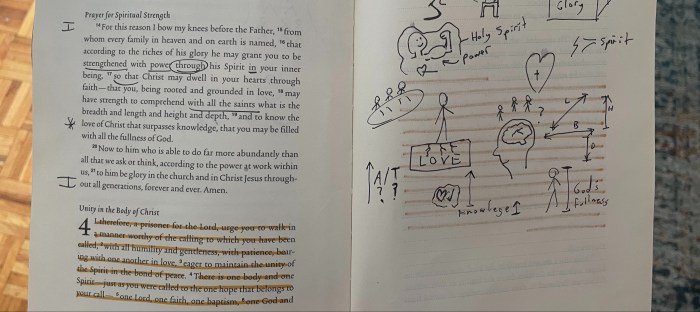
During a 4-month sabbatical this summer I took on a personal challenge to memorize the whole book of Ephesians; all 155 verses in 6 chapters. The spiritual value and joy I found in memorizing Paul’s most theologically concise epistle was so worthwhile that I squeezed in his letter to Titus as well, another 46 verses. Having benefited from this experience, I can’t help but to encourage and challenge anyone to consider doing this as well. Here are 10 things I’ve learned.
- Inspired by a 10 year old blind girl. In 1830, a blind ten-year-old girl named Fanny Crosby embarked on her journey to memorize five chapters of the Bible each week. By age fifteen, she had committed to memory the four gospels, the Pentateuch, the Book of Proverbs, the Song of Solomon, and many Psalms. When I read her testimony to my kids it put a conviction on my own heart that if she could memorize that many whole books of Scripture then I have no excuse not to at least try to memorize one! She went on to have an amazing ministry and wrote thousands of hymns for the church with some still being sung today. “Show yourself in all respects to be a model of good works.”
- “Transformed in the renewal of your minds…” This challenge has shown me that our minds possess greater potential than we often realize. God has wired our brains like super-computers and yet my lack of attention span and memory retention takes this for granted far too often. I took on this project as a stretch of faith and have seen God’s grace in doing “far more abundantly” than what I normally “ask, think, or imagine.”
- It’s harder to memorize 201 random verses than a continuous stream of thought. Memorizing Scripture as a comprehensive thought, rather than isolated fragments out of context, enhances our grasp of its true meaning. Scripture was originally written as a complete thought, and retaining the integrity of the thought process helps us understand the whole message and its broader connections.
- You could do this any day. While I was able to dedicate more time to memorization during my sabbatical, I found that the most fruitful moments occurred during ordinary times available for anyone. Late-night strolls through the neighborhood or during long car rides were the best for me to listen to and recite God’s Word. Making Bible-memory a normal part of life is achievable for (most) anyone.
- “Make the best use of the time because the days are evil…” With entire books of Scripture ready at hand I find myself less susceptible to aimless thoughts or boredom. Whether waiting in a car shop or walking to a store or trying to fall asleep at night, I am never lacking a book to read for meditation and prayer.
- Human authorship of Scripture. “…Paul, an Apostle of Christ Jesus by the will of God, to the saints who are in Ephesus…” The process of memorizing someone’s written words highlights their own distinctive characteristics, patterns of emphasis, and unique ways of expression. Understanding the personalities of the human authors sheds a different light on God’s Word.
- Divine authorship of Scripture. “…how the mystery was made known to me by revelation as I have written briefly…” Memorizing and meditating on the length, breadth, depth, and height of God’s eternal plan of salvation and revelation is mind-blowing on a deeper level than we normally find in cursory reading. Scripture reveals the profound nature of God’s mind and the intricate tapestry of salvation woven through the words of the human authors.
- Memorization plants the seed of the Word deep in the heart. As Scripture becomes deeply embedded in the mind, its words and ideas interconnect in fascinating ways. The more we immerse ourselves in whole books, chapters, and verses, the more evident the intricate relationships between different parts of the Bible become, and the more powerful each word lands in its implications for our lives.
- “And take the sword of the Spirit, which is the Word of God…” Memorizing Scripture equips us with a readily accessible reference of “such words as are good for building up, as fits the occasion, that it may give grace to those who hear.” Bible memory is an invaluable resource for storing up the words of Scripture to use at just the right times for prayer, preaching, and offering words of encouragement.
- “So that no one may boast” As with other things, growing in spiritual disciplines and then encouraging others to do the same can easily fluctuate from being humbled in God’s grace to taking pride in personal achievements. Experts in Scripture could retain the letter of the law without a heart of love, Satan could recite Scripture to Jesus without a heart of worship, and any one of us can stuff a lot of Bible Words in our brain without a pure heart for God. Memorizing Scripture is not a magic wand for holiness, and apart from God’s grace, Bible-memory is worthless. But, for those in Christ, “these things are excellent and profitable for people.”
The things I’ve learned about memorizing Scripture don’t compare to the things I’ve learned from memorizing Scripture. Consider the challenge yourself and allow me to encourage you to do it!
 Evangile Quebec